
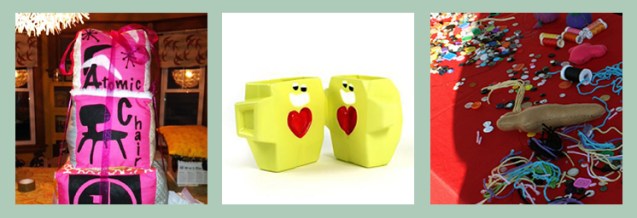
“Without play, there would be no Picasso. Without play there would be no experimentation. Experimentation is the quest for answers.”
–Paul Rand
Design permeates every aspect and period of life. Childhood is no exception. Phenomenal toys engage children on many levels, offer opportunities for discussions, pose questions, and promote curiosity. In addition, the mark of a well-designed toy is its environmental footprint. I have a particular penchant for toys that are either temporal creations, from tactically using found objects where the objects can be returned, and for toys that are both made with environmental awareness and able to be an heirloom. Two wonderful children’s toys are Rob Spalding’s UBBAS, and Tom Flemon’s Skwish.
Toys are designs that can evoke joy, creativity, and curiosity. They are designed to be played with. Before this happens, the toys must be selected, first by the adult who gifts the toy to the child and then by the child herself. How are toys selected? How are toys intended to be used? How are toys used by the individual?
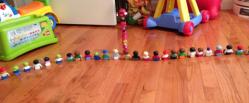
“Citizens! Hearken to my words!” Duplo Block figures arranged by four-year-old child to listen to M and M character speak. February, 2013. Image courtesy of Harlan Freilicher.
Toys, perhaps more than any other area of design, are performative in nature. What do I mean by this? I mean that while designers may intend a toy to be used in a specific way – even if the toy is designed to be open ended, such as wood blocks– children may not use a toy the way the design was envisioned. In fact, this is highly possible. In addition to exploring the tactics and strategies of toy designs, Toys will examine designs that elucidate the two central questions of designIVspace: What unifies us as humans? What does it mean to be human?
Explore!
Stitching Connection: 44 Daughters
 design IV space