
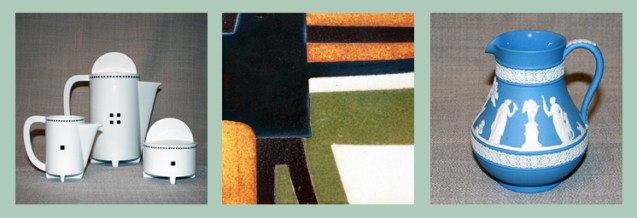
CERAMICS: AN INTRODUCTION TO A UNIVERSAL DESIGN SOLUTION AND A RECORD OF TECHNOLOGY AND AESTHETICS
Ceramics is a design solution that serves as a record of technology and aesthetics. Technology enables the transformation of ceramics from utilitarian objects to sheer form. While technological advancements and aesthetic developments occurred in different periods in various regions, ceramic traditions connect people globally because ceramic traditions developed throughout the world. Thus ceramics reveal both universal human experiences and the specific political, social and economic dynamics of the time and place they were created.
Tor Viking Cooking Pot, Turi Gramstad Oliver(b. 1938) for Figgjo, Norway, 1966 -1968, Vulcanus quality porcelain, 24.5 cm diameter x 15 cm tall
If ceramics are design solutions, why do people create ceramics? What are the universal design challenges that ceramics address that make ceramic traditions ubiquitous? One notable design challenge is how to store, cook, serve and eat food. Here, ceramics prove to be a design solution.
The progression of ceramic technology and aesthetics might appear linear. However, cross-cultural pollination brought about through trade and increasing globalization make ceramic history more fluid. Why? Migration of ceramic makers, coupled with traders exporting and importing, explorers and visitors bringing ceramics, its knowledge, and sometimes the specific clay for ceramics itself around the globe influenced the fluidity of ceramics’ technological and aesthetic history.[i] Ceramic aesthetic development is contingent upon ceramic technological advancements. What is needed for ceramic technological advancement and therefore ceramic aesthetic development? Prerequisites for creating ceramics are clay, makers, and knowledge. These three things are needed to create ceramics, a universal design solution.
CLAY- THE MUD OF THE EARTH
Clay – the base material of ceramics – is sourced all over the planet and is highly maleable. When combined with specific minerals, glazed, and then fired, clay becomes impervious to water. Clay’s attributes permit ceramic traditions to exist globally. Its malleable nature allows the maker to construct ceramics using many techniques. Pinch form, coil built, and slab assembly are construction techniques relying predominantly on the human hand. In contrast, wheel thrown and slip cast are techniques made possible through technological innovation that involves tools beyond the human body, expanding the speed and consistency of production.
MAKERS- INDIVIDUALS AND CENTERS
When one thinks about great ceramic makers, centers of ceramics throughout the world come to mind just as readily, if not more so, than the names of individual makers such as Bernard Leach, Adelaid Alsop Robineau, Shōji Hamada, and Prem. Those who made ceramics in state-supported ceramic centers — including the kilns of Jingdezhen, Manufacture Royale de Sevres, and Königliche Porzellan-Manufaktur — benefited from stable environments that allowed each particular ceramic tradition to flourish. While recent scholarship addresses the previously disregarded ceramic traditions of nomadic societies, the political, economic, and social stability of sedentary societies, as well as specialized divisions of labor undoubtedly aided the achievement of ceramic technological prowess.[ii]
The makers of ceramics provide insights into historical changes in production and labor, including division of labor. The question of who made a ceramic is a worthwhile line of inquiry that in itself brings insight into the time and place in which a ceramic was made. While exploring such questions, examining the universal can prove as rewarding as looking for the distinct.
KNOWLEDGE
Fortunately, there are always makers to make. The knowledge of how to make a piece such as Adelaid Alsop Robineau’s Apotheosis of the Toiler, a pierced and enameled painted porcelain vase, does not always exist. Invariably, knowledge of best practices in ceramic making is gradually built as it is passed from generation to generation. This was done formally through apprenticeship, guilds, and schools. The knowledge base for making ceramics is vast and includes clay preparation, glaze recipes, construction of form, design and use of tools, drying and firing techniques, and kiln construction.
The higher the temperature of clay when it is fired, the stronger the resulting ceramic will be. At a certain point, however, the integrity of the form can be destroyed or compromised by heat that exceeds the limits of the ceramic’s body. The more controlled and consistent the firing source, the more consistent the yield of ceramics will be. While much of the advancement in ceramics involved creating recipes for clay bodies and glazes that could withstand ever-increasing firing temperatures, trial and error also played a notable role in the history of ceramic technology.
Having the resources to experiment through trial and error in all aspects of the making process was critical in the advancement of ceramics. Documentation of ceramic technology around the leap from faiance to porcelain in Europe demonstrates the complexity and importance of trial and error. It is through trial and error that process flaws are discovered and adjustments can be made, thus leading to the knowledge essential to developments in ceramic making.
TECHNOLOGY THEN AESTHETICS
The more advanced the technology, the more nuanced and varied aesthetic expression can be. For example, Grain Jar, from the Song Dynasty, demonstrates an advancement — that of successfully firing figurative porcelain — and therefore is able to express specific aesthetics of the Song Dynasty, conveying narratives of Buddhism in a serene, pale celadon.[iii] Coveted by the rest of the world, the ceramic traditions of Asia, China in particular, showed the earliest mastery of many ceramic technologies. As a result, Chinese ceramics express highly varied aesthetics. Nonetheless, ceramic traditions of the Americas, the Middle East, Africa, and Europe each reveal that we as people are more similar than different. The thirst for knowledge, the ability to problem solve through trial and error, the need to have a pot to cook food, and the desire to imbue aesthetics into that which we create are universal truths that ceramics reveal.
CERAMICS AS UNIVERSAL
Found and used almost everywhere on the globe today, ceramics date back to 20,000 BCE.[iv] Available in endless shapes, sizes, colors, and patterns, ceramics, in addition to being extant records of a history of technology and aesthetics, are design solutions. Each ceramic has something to teach us about what it means to be human. Ceramic vessels can do all of this. It is this versatility coupled with durability that makes ceramics desirable to all and a part of a shared human experience.
In contrast, technology and aesthetics can reveal specifics of the time and place in which the ceramic is made. Ceramic production throughout the world can reflect the individual histories under the universal umbrella of design solutions for necessity. This is revealed through studying individual ceramics, groups of ceramics by the same maker or a group of makers from a specific period or place, and then comparing individual ceramics from these groupings. While such studies lead to connoisseurship of ceramics, the focus remains on examining this material culture as an entry into understanding the impact of their histories. It is through knowing the specific that the universal is understood.
NOTES
[i] Beginning with the Silk Road, continuing with Niccolò, Maffeo andMarco Polo in the 13th century, the establishment of Portuguese trading posts including Macau in the 16th century, Dutch trade beginning in the 16th century through the establishment of the VOC in 1602, and the East India Company starting trade with Thailand in 1612 Chinese ceramics were slowly then in greater quantities exported to the Middle East and eventually Europe. See:Lunsingh D. F. Scheurleer, Chinese Export Porcelain = Chine De Commande. New York: Pitman Pub. Corp, 1974. Also See: Duncan Macintosh, Chinese Blue and White Porcelain. Hong Kong: Book Marketing, 1997. Spanish lusterware, commonly referred to as maiolica imported into Italy spurred Italian production of its own wares in centers widespread throughout Italy including Urbino , Gubbio, Naples and Venice. See Rosamond E. Mack, Bazaar to Piazza: Islamic Trade and Italian Art, 1300-1600. Berkeley: University of California Press, 2002, 95 -112., David Harris Cohen, and Catherine Hess, Looking at European Ceramics: A Guide to Technical Terms. Malibu, Calif: J. Paul Getty Museum in association with British Museum Press, 1993. 56 and Howard Coutts, The Art of Ceramics: European Ceramic Design, 1500-1830. New Haven, CT: Yale University Press, 2001, 15- 45.When Karl Muller immigrated to the United States from Germany in 1850 and then was hired in 1874 by Thomas C. Smith at the Union Porcelain Works in Brooklyn, migration made it possible for the creation of the ceramic masterpiece The Century Vase in the United States. See Alice Cooney Frelinghuysen, American Porcelain, 1770-1920. New York: Metropolitan Museum of Art, 1989, 33 -35. The ceramic tradition in Arita Japan flourished when clay was imported in the early 16th century when Gorodayu-go Shonzu purportedly came back to Japan after studying ceramics for 5 years with porcelain clay to produce porcelain in Arita, Japan. See Hazel H. Gorham, Japanese and Oriental Ceramics. Rutland, Vt: C.E. Tuttle Co, 197, 113- 114.
[ii] An additional correlation between sedentary societies and ceramic production is they afford the neccessary time needed to dig, prep, dry, and fire the clay – activities that would conflict with the seasonal migrations of nomadic life. See Jelmer W. EerkensJelmer Eerkens, “Nomadic Potters: Relationships between ceramic technologies and mobility strategies” in Barnard, H., and Willeke Wendrich, The Archaeology of Mobility: Old World and New World Nomadism. Los Angeles: Cotsen Institute of Archaeology, University Of California, 2008; 307-326. (http://www.academia.edu/1038708/Nomadic_Potters_Relationships_between_ceramic_technologies_and_mobility_strategies)
[iii] [iii] See Exhibit #7 in the 2005 exhibition “From the Ground Up: 5000 Years of Ceramics” shown at Palisander, Ltd., The D & D Building, New York, NY.
[iv] Gideon Shelach, On the Invention of Pottery Science 29 June 2012: 336 (6089), 1644-1645. [DOI:10.1126/science.1224119] http://www.sciencemag.org/citmgr?gca=sci%3B336%2F6089%2F1644
Explore!

“From the Ground Up: 5000 Years of Ceramics“
Make! Clay
 Museum Treasure Hunt: Ceramics!
 design IV space